


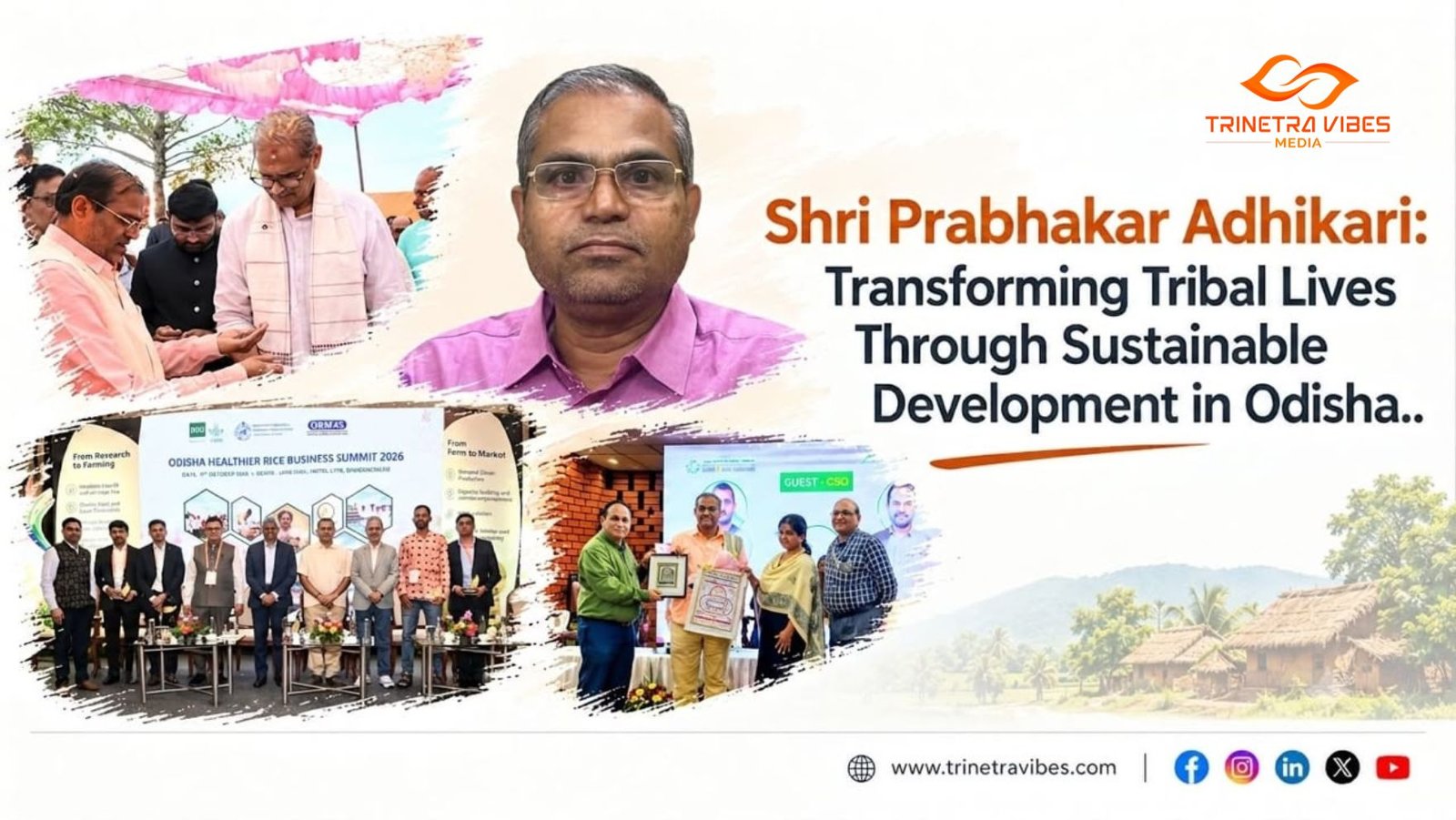
Founder Story | Pragati Koraput | Tribal Development | Sustainable Agriculture
For more than three decades, Shri Prabhakar Adhikari, Founder Secretary of Pragati Koraput, has worked to improve the lives of tribal and rural communities in Koraput, one of the historically underdeveloped regions of southern Odisha. Since founding Pragati in 1992, his mission has been to help marginalised communities overcome poverty, food insecurity, seasonal migration, and limited access to sustainable livelihood opportunities.
Through his grassroots approach, Shri Adhikari has helped build a community-led model of rural development that combines sustainable agriculture, forest conservation, water security, women’s empowerment, and rural entrepreneurship. Under his leadership, Pragati has grown into a recognised development organisation working alongside seven Farmer Producer Organisations (FPOs), with programmes that have directly and indirectly reached more than one lakh rural and tribal households across Koraput and neighboring districts.
Building a Foundation for Tribal Development
Shri Prabhakar Adhikari’s journey began with the understanding that lasting development requires more than short-term assistance. Tribal communities needed secure access to land, better farming opportunities, reliable water resources, and stronger connections with markets and government programmes.
Pragati focused on community participation, traditional knowledge, and sustainable use of natural resources. Over time, this approach evolved into an integrated development model connecting agriculture, forest rights, livelihood diversification, and community-owned institutions.
One of his significant contributions has been strengthening forest rights among tribal communities. Through Pragati’s efforts, the district-level federation Zila Banabasi Sangh was formed, covering 1,047 villages. During the implementation of the Forest Rights Act (FRA), 1,704 Forest Rights Committees were formed and strengthened.
According to programme figures, 37,156 individual forest rights claims were submitted, with 27,676 tribal families securing legal recognition of forest land rights over 42,408.44 acres. Additional support through government schemes helped families access housing, horticulture, water-harvesting structures, and employment opportunities.
These efforts strengthened both livelihood security and community participation in forest management.
Promoting Sustainable Agriculture and Indigenous Rice
Agriculture remains central to tribal livelihoods in Koraput. However, small landholdings, unpredictable rainfall, and limited market access have often restricted farmers’ incomes.
Under Shri Adhikari’s leadership, Pragati promoted climate-smart farming practices, including the System of Rice Intensification (SRI), which reached 45,525 farmers across more than 15,849 hectares in 233 villages.
The organisation also supported organic and natural farming through Participatory Guarantee System (PGS) certification, enrolling 3,000 farmers. In addition, 748 Integrated Farming System models were established across 14 blocks, alongside 21 Community Bio-resource Centres and 10 community-managed seed banks.
A major part of this work has been conserving traditional agricultural knowledge. Pragati has promoted more than 40 indigenous rice varieties, including Kalajeera, Black Rice, Basabhoga, and Macha Kanta.
In 2024, one of the Farmer Producer Organisations supported through these efforts received a Geographical Indication (GI) tag for Koraput Kalajeera Rice, popularly known as the “Prince of Rice.” Pragati also supported market opportunities for indigenous rice and was selected under the Government of Odisha’s Amruta Anna scheme to supply aromatic rice to the Shree Jagannath Temple for Kotha Bhoga during Rath Yatra.
These initiatives connect agricultural heritage with better market opportunities and more sustainable farming practices.
Reviving Mil lets and Strengthening Farmers’ Incomes
Shri Adhikari has also contributed to the revival of millets in tribal Odisha, helping restore the importance of these nutritious and climate-resilient crops.
Through Pragati’s interventions, more than 13,562 tribal farmers adopted millet intensification systems across 12,317.5 hectares, while 56 indigenous millet varieties were conserved and revived.
The organisation supported market linkages and Minimum Support Price (MSP) procurement through the Odisha Millet Mission. By 2025, institutions supported through these efforts had cumulatively procured more than 161,000 quintals of finger millet, benefiting thousands of small and marginal tribal farmers.
These initiatives have helped improve market access while promoting millet cultivation as an important part of nutrition security and climate-resilient agriculture. The work also contributed to wider research discussions, including an international journal publication in 2023.
Water Security and Renewable Energy for Rural Communities
Reliable water access is essential for farmers who depend on rainfall. To address this challenge, Shri Adhikari supported the development of 122 community-based diversion irrigation systems, gravity-fed channels, farm ponds, dug wells, watershed interventions, and solar-powered irrigation models.
According to programme figures, more than 3,200 small and marginal farmers gained irrigation access, enabling them to diversify into pulses, spices, vegetables, and integrated farming. Some families began generating annual incomes of ₹1 lakh to ₹3 lakh through diversified agricultural activities.
By 2025, more than 750 farmers were directly benefiting from renewable-energy irrigation systems established through Pragati and its seven FPOs. The organisation also promoted solar-based drinking water systems and solar dryers to support rural livelihoods.
These innovations earned Pragati international recognition, including the Kyoto World Water Grand Prize at the World Water Forum in Dakar, Senegal.
Building Farmer Organisations and Rural Enterprises
Recognising that individual farmers often struggle to negotiate fair prices, Shri Adhikari focused on building farmer-owned institutions that could improve market access and collective bargaining power.
By 2025, Pragati had facilitated 947 Farmer Producer Groups involving more than 21,850 farmers and supported seven Farmer Producer Companies with over 9,200 tribal shareholders.
These institutions work with crops such as millets, indigenous rice, turmeric, ginger, vegetables, maize, tamarind, and pulses. Their activities include aggregation, procurement, processing, marketing, and value addition.
This model has helped farmers move beyond subsistence agriculture towards organised rural enterprises, creating opportunities for stronger incomes and sustainable economic growth.
Empowering Women and Creating Opportunities for Youth
Women’s economic empowerment has been another important part of Shri Adhikari’s work. Through livelihood and enterprise development programmes, women have received support to establish poultry units, goat-rearing businesses, tailoring services, food-processing ventures, grocery shops, and other local enterprises.
By 2025, more than 2,950 women entrepreneurs had been supported. Some women-led businesses generated monthly incomes of ₹5,000 to ₹15,000, while livestock and allied activities provided additional annual earnings.
The organisation also focused on tribal youth, many of whom faced unemployment and migration. Nearly 6,900 rural youth had been mobilised through producer groups, agricultural enterprises, and value-addition activities by 2025.
Training in modern agriculture, irrigation, renewable energy, and entrepreneurship helped young people explore opportunities in farming and rural businesses, including the possibility of building livelihoods closer to home.
Supporting Communities During COVID-19
During the COVID-19 pandemic, Pragati expanded its relief and livelihood support under Shri Adhikari’s guidance, reaching more than 30,000 vulnerable households.
Its efforts included food and ration distribution, migrant support, health awareness, masks and sanitiser, and assistance to maintain agricultural activities. Farmer Producer Companies also helped sustain local food systems and vegetable marketing during lockdowns.
The organisation supported employment convergence through MGNREGS and helped migrant families explore farming, livestock, and enterprise-based livelihoods. This response highlighted the importance of strong community institutions during periods of crisis.
Recognition, Partnerships, and Lasting Impact
Over the years, Pragati has collaborated with institutions including the Government of Odisha, the Government of India, the International Rice Research Institute (IRRITANT), ICRISAT, ICAR-CIFA, NABARD, IFAD, and APEDA.
The organisation has received several recognitions, including the Keeling Curve Prize, the Kyoto World Water Grand Prize, the Nexus of Good Award, the India NGO Award in 2007 and 2008 in the small category, and recognition from the Odisha Environment Congress.
These partnerships and awards reflect the wider relevance of its work in sustainable agriculture, water management, climate adaptation, and community-led development.
A Vision for Self-Reliant Rural Communities
Shri Prabhakar Adhikari’s journey with Pragati Koraput demonstrates how consistent grassroots engagement can create meaningful change. Over more than three decades, his work has helped strengthen forest rights, revive indigenous crops, improve irrigation, support farmer-owned enterprises, and create opportunities for women and rural youth.
The impact extends beyond numbers. It lies in helping communities gain greater control over their livelihoods, resources, and economic future while preserving their cultural and agricultural heritage.
For aspiring social entrepreneurs, development professionals, and individuals who want to contribute to society, his story offers a valuable lesson: lasting change begins with understanding people’s needs, working alongside communities, and remaining committed to practical solutions.
Through more than three decades of dedicated service, Shri Prabhakar Adhikari has helped turn community participation into a foundation for dignity, resilience, and sustainable rural development in tribal Odisha.